With all that’s going on
these days relating to Brian de Palma, I was thinking that over here at Toronto Film Review that I should complete the overview of Cahiers du Cinéma’s writing on him after having already
posted overviews of their eighties and two-thousand periods. A general context
of these critiques at the magazine emerges after having now read and translated
all (or at least most) of their critiques.

The following is a short
overview of the relation between Cahiers and Brian de Palma: At first there was
Pascal Kané introducing de Palma at the magazine through an analysis of his
early horror films (Phantom of the
Paradise, Sisters, Carrie) in the June 1977 issue (N.277); Jean Douchet
would prod the late seventies critics on not liking de Palma which would lead
to a discussion on the subject in the July-August 1981 issue (N.326) which is
also the catalyst for Serge Daney to interview de Palma himself in their
special Made in U.S.A. 1982 issue
(N.334-35); then there were the early eighties critics such as Alain Philippon,
Michel Chion and Olivier Assayas who provided the groundwork by reviewing these
de Palma films (Dressed to Kill, Blow
Out, Body Double); in the nineties Iannis Katsahnias is important for
writing about Casualties of War and Mission: Impossible, Thierry Jousse on Raising Cain, Jean-François Rauger on Carlito’s Way, and Cédric Anger also on
Mission: Impossible; with the dawn
of the two-thousands there were new critics picking up the de Palma torch so
both Emmanuel Burdeau and Stéphane Delorme (his first text) wrote on Snake Eyes (and later Mission to Mars), Jean-Marc Lalanne on Femme Fatale, Hervé Aubron on The Black Dahlia, and many of these new
critics (with some new ones) on Redacted,
before the new editorship would give Passion
a dossier which included a lengthy interview, a critique by Stéphane du
Mesnildot, and an interview with Pino Donaggio.
Throughout these texts de
Palma reaches a peak in the late nineties (with Carlito’s Way getting voted as the best film of that decade) after
a mostly triumphant eighties period. De Palma at Cahiers offers the successive post-new wave generation of critics an
opportunity to discuss and how to think of a cinema in a Hitchcockian
filiation. Giving them an opportunity to discuss the lessons of the master and
building off these lessons for a new historical moment, which with it includes
new truths, technologies and spectator expectations. De Palma should also be
contextualized along with other (quasi-)outsider American filmmakers, such as
Clint Eastwood and Abel Ferrara, that have allowed Cahiers to better appreciate the portrayal of the
country’s shadow reflections.
Hopefully all of this de Palma attention,
screenings and writing doesn’t only offer nostalgic fantasies of an earlier and
trashier cinema but can be the springboard for his cinema and his ideas to
shape, influence and reinvigorate a new generation of filmmakers and the future
of things. Aside from Quentin Tarantino, J.J. Abrams, Nicolas
Winding Refn (The Neon Demon), David
Fincher (best argued by Laurent Vachaud), Steven Soderbergh (Side Effects, The Knick), Vince
Gilligan and maybe Cameron Crowe (Aloha),
probably the two of the most exciting new films that were made in his shadow
are the political corruption Indonesian film Joko Anwar’s A Copy of my Mind (2015) and the moon landing conspiracy thriller Matt
Johnson’s Operation Avalanche.
De Palma shouldn’t only influence mainstream
mid-, late-career filmmakers who have the means to their disposal as de Palma’s
model still offers some of the most stimulating ideas on the possibilities of
filmmaking. More independent filmmakers should try to make work in de Palma’s
shadow: How to think about the fictional veil of images? How to engage with the
great work and masters of film history? How to bring back old fashioned
techniques (split-screen, long-takes) and make them new again? How to engage
with new technologies and new spectator expectations? Essentially, what truths
are there to be told today and what’s the best way to tell them? – D.D.
***
The Bonfire of the Vanities (Cahiers,
March 1991, N.441), w/ Notes sur d’autres films critique by Iannis Katsahnias.
After getting
torn apart by the American critics, The
Bonfire of the Vanities arrived to France with the reputation of being the
worst movie of the year – a total failure of 45 million dollars – and one of
the worst commercial disasters since Ishtar…
Before going on, we’re forced to ask ourselves a simple question: Is it really
that bad? The answer is: no. It’s a simple comedic diversion… Adapting the Tom
Wolfe book (which the fans might prefer), this adaptation from the auteur of Dressed to Kill should be considered
along some of his most contested enterprises (Scarface, The Untouchables). I can’t find anything here that’s
worthy of his best mise en scène… Though there is the opening scene: a five
minute long-take where the camera follows Peter Fallow (the narrator played by
Bruce Willis) at his arrival where he’s accepting a literary prize. But it’s
only a technical tour de force that tries to recreate the illusion of live-ness which is medium-specific to
television. By going against the grain while telling this story full of
Hitchcockian situations (e.g. the divide between culpability and innocence),
Brian de Palma returns to a coldness, misanthropy and the cynicism of the last two
films of the filmmaker he most fetishizes.
***
Raising Cain (Cahiers,
October 1992, N.460), w/ Cahiers Critique by Thierry Jousse, Citizen Cain.
Raising Cain is for Brian de Palma a
return to the maniériste horror
cinema that he’s always been into. After the failure of The Bonfire of the Vanities, he needed to without a doubt return to
this familiar terrain that he has abandoned since Body Double, which already seemed like both a limit point and a
point of no return in terms of its subject matter… Raising Cain is then a sort of post-script – the last one, without
a doubt? – to the parody perfume of his earlier accounts of Hitchcockian
variations but now he pushes it to the point of saturation which it seems like
it would now be hard to surmount… Just like a painter, de Palma isolates a
detail from Psycho and diffuses it
in variations throughout the film. Here it’s the schizophrenic split
personality that’s being explored: it’s no longer the mother who’s responsible
for the abuse but more simply just the father. In short Raising Cain multiplies the doubles in all of its potential
variations with all sorts of simulacrums and events that can possibly
proliferate from the base psycho motif…
In fact its scenario is in its own way exemplary. It points by way of absurdity
the perversion of remakes and the dangers of simulacrums. The principal
character Cain is the victim of paternal manipulations who has dragged him
along since childhood. As any respectful schizophrenic would, Cain has lost all
references to any initially fixed identity. So all that is left are these
copies that live on in their own lives with no reference to the original… This is
exactly the situation of de Palma’s films, which all the while being entirely
in submission to the hard laws of the Hichcockian father, attempt to emancipate
themselves. He then risks the possibility of reaching a level of uncertainty that
can then become dangerous (see: an impossibility to exist without the relation
to the father)… We would understand that Raising
Cain, all the while a being a thriller that alternates between the best and
worst scenes, is especially a pure mental construction, which makes it more
like a theoretical film. But what we see in the oeuvre itself is a game with
the spectator, which mixes traditional devices of suspense with a distancing
parody that is pretty perverse, all which is being adapted at a time of new
technologies and video games… There is first off a story that is totally
improbable which we don’t really understand, as if the mental confusion of the
hero has literally contaminated the film. And then, fast enough, we notice that
de Palma, loyal to himself, is trying to construct his own space-time animated
only by the logic of his phantasms… So we slide from a dream sequence to a flashback,
we jump from a mental image to a quotidian scene so that we slowly loose track
of the time of the story. De Palma has contempt for the naturalism that has doesn’t
have joyousness. Throughout its narration, de Palma uses means that are
sometimes coarse, sometimes clichés, but always thinking with the spectator as
he gives them the means to be conscious of the dupery that they’re going
through so then that they could surmount they’re provisionary blindness… So
there’s the exchange of gifts between the wife and her lover (an idea that
curiously recalls Montparnasse Levallois
the sketch by Godard in Paris vu par…)
or the wig of the psychiatrist which is described earlier on in the story as it
usually happens as easily read motifs of the phantasms that contribute to the
pictorial visibility of the mise en scène… One must eventually come to the
question that for de Palma is evidently central, since for him everything is mise
en scène. From this point of view, Raising
Cain is a kind-of strange object that mixes bad taste with an ugliness along
with other various ideas about filmmaking but with an audacity that would
embarrass all of the little masters quasi-Hitchcockian filmmakers that are popping
up everywhere these days in Hollywood. There is for de Palma an ontological
ugliness of the close-up that culminates in the first quarter of the film, and
particularly with the first doppelganger of John Lithgow who rubs against or
even surpasses the ridiculousness proper to him… If there is an obscenity in Raising Cain it is first off in the
grating faces that de Palma seems to look at with repulsion (which is a paradox
for a metteur en scène!). On the other hand, when he decides to film in wider
shots and to organize space in the frame or in the function of a sophisticated
montage he then gets to a beautiful formalism that, never gratuitous, seems
usually tied to a sexual jouissance… The official critics, American just as
much as French, dismissed Raising Cain
as they described it as too out-there, ridiculous or qualifying it as a ‘large
psycho-paternal pudding’ (Danièle Heymann, Le
Monde), as they prefer films where the aesthetic doesn’t create any ripples
and would never commit any offences against good taste. If he is sometimes at
the limit of self-sabotage, the films of Brian de Palma do not at all merit
this contempt while on the other hand they shine of all of the pleasures of the
cinema. He has no peer. Raising Cain is
finally the joyous antidote to the general normalizing aesthetic.
***
Carlito’s Way (Cahiers,
April 1994, N.478), w/ Film du Mois critique by Jean-François Rauger, La Mort aux trousses; and Sequence essay
by Vicent Ostria, Passage de la boule
blanche.
The virtuous
opening scene immediately indicates the nature of the story for Brian de Palma.
A man dies. He’s lying on the ground. He remembers the past. Carlito’s Way begins in a similar
manner to that of Clint Eastwood’s A
Perfect World. How to program two-and-a-half hours like a mental trip? Where
the frontier between the imaginary and the réel is indiscernible and where the
spirit pushes itself into the heart of an ideal world that of a dreamt
universe. Carlito’s Way is the
reunion, ten years after Scarface,
of the auteur of Carrie with Al
Pacino. This distance is concretely present in Carlito’s Way where all of the energy of the remake of the Howard Hawks film has been refined and concentrated
in its pursuit of its mature protagonist who is given a second chance…
Everything will return to the oneiric path that confronts the grace of a dream
with the weight of the réel. The months that separate the departure from prison
by Carlo Brigante leading to his violent end at the Grand Central terminal are
restituted like a somnambulist itinerary, which are punctuated by subtle
flights and displacements… The end scene of the concrete image of a dead
Carlito in the New York train station is similar to that of Kevin Costner in A Perfect World who is lying down in
the grass like dreamer and where you could see the massive and loud silhouette
of a helicopter above him. There is a shared menace of the social order in
conflict with the promise of a different world without all of its problems… The
image of the Bahamas advertisement, which the film would return to at the end of
the film, would start to move. What exactly is a cliché if not a stopped image?
What is de Palma’s project if not to try to stop this image? That this image
starts to transform is an a priori movement
determined to become and appear somewhere where it’s not expected… It is
certainly not impossible to see Kleinfeld like the negative of Carlo Brigante.
But the character of the lawyer means a lot more than that. He surely incarnates
the dialectic, which constitute the cinema of Brian de Palma, that of the
opposition between a triviality with a nobleness, the attraction and repulsion
that represents the sentiment tested vis-à-vis the vulgarity like an obligated
test. The scene where Kleinfeld gives the gangsters he invited a hard time during
his garden party is funny because it illustrates especially the obligation for
those who want to be criminals. Like how they are confronted with the baseness
of reality. Like de Palma himself by stealing from Hitchcock he had to be
confronted with it because of his own proper contemporaneity that which is in
evidence due to his triviality and sexually sordid details. In this regards, Carlito’s Way re-finds all of the bad
taste that corresponds to the imagination of its characters who don’t have any
qualities and who testify to their
incredible vitality… Carlito’s silhouette is that of a revenant, that of an
individual defined by a prestigious past that has then become mythological. The
magnificent interpretation by Pacino gives to the character the lassitude (‘I’m so tired…’ are his last words) of
the one who arrives after the fact.
There is without a doubt that Godard’s Detective
can be re-found here as this tired shadow who popped up in this
disreputable genre film… The cinema of de Palma has definitively experienced
its own mourning over the loss of innocence of images. Images, which today have
lost their virginity, can no longer be taken at face value by the spectator.
This loss of belief is here the prior terrain of an operation that aims to transform
the nature of what is shown for, by the end, restore the illusionary belief of
the spectator. Courtland in Obsession
folded reality to render it conforming to his dream of the repetition of a
primary scene. De Palma restitutes in Carlito’s
Way a world that belongs to the dreams of his hero. But here, like in Obsession, the all-encompassing power
of a desire impregnates the totality of the universe that is rendered
absolutely credible and experienced in that mode with the laws of reality. In Obsession, it was the machination of
the absolute completion of something unrealizable while here it’s the hope at
the end of the un-finishing chase, of the place that is never attainable. How
to believe in the image that of Pacino fleeing towards his paradise (that of a
train taking him to Miami) when we see him already getting killed right at the
beginning? The force of the film is there. Reconstruction of that belief while
the cards are already set. The cinéaste re-finds his way with an authentic
lyricism, full of energy and which is much lacking from most of contemporary
American cinema where these technical calculations never fully open up towards
an emotion. Here is finally a project that distances itself (as always, let’s
hope) that of the Brian de Palma of his last few cynical oeuvres from recent
years (The Untouchables, The Bonfire of the Vanities)… Carlito’s Way situates its action in
the seventies, the period where de Palma was discovered as the foremost
maniériste Hollywood filmmaker who was also dialoguing with its origins. The
film definitively conserves this maniérist cold virtuosity, reassessment, and
stretching. But this historical moment is here re-seen like the adolescence of
an art that now has to lean upon itself and by continuing to understand how to
mature, with the risk that all they could have experienced came from references
of the mythic past, then what could the present look like when there are no
longer any illusions? The period for autobiography has arrived.
Vicent Ostria in
his close-reading of the pool hall scene Passage
de la boule blanche (also a reference to the historical street the Cahiers office was on),
The complexity
and rhythmic organization of this micro-scene in a film that is otherwise
anti-spectacular (at least for de Palma) proves that Brian de Palma remains one
of the best, maybe one of the last great stylist of American cinema. We can
doubt that a French action filmmaker (Boisset or Besson) could have only done
something like this through a few boring shots.
***
Mission: Impossible (Cahiers,
September 1996, N.505), w/ Letter from Hollywood essay by Bill Krohn, Tornades, Martiens et ordinateurs.
The two major
economic successes, Twister and Mission: Impossible, are both films
that are realized by metteur en scènes that are sensible to a cinematographic
modernity but who still choose to align themselves in the descendance of Alfred
Hitchcock… While Roland Emmerich’s Independence
Day, which is underwhelming, is made under the sign of Spielberg and
Lucas…. Between the commercial stakes and an ideal cinephilic ego these films
offer a nodal point for the trends of the new Hollywood action film… Twister confirms that Jan de Bont is
the best action filmmaker in Hollywood today… At first all of small-time action
filmmakers were ripping off Die Hard but
now they’re copying Speed. This
catapulted the ancient member of the Netherlands New Wave to the A-list of Hollywood…
De Bont’s major skill and what he brings that is new is to get the participation of the public while
watching his films… Speed is one of
the most theoretical films in the history of cinema.
Brian de Palma
already understood the new relation of the public to the spectacle when he made
this film that subsumed to the laws of the studios. With Mission: Impossible he signed his first real success since The Untouchables but this time here, despite
rumors that suggested he had problems with his producer Tom Cruise, it’s
essentially a de Palma film that he made because, among other things, there are
in fact in Mission: Impossible three
films that are really different… The third time that I saw it there were so
many more details that were revealed… Once Ethan’s original team gets killed, his
new team in Mission: Impossible is composed
of losers who are meant to fight back
against the CIA, which allows de Palma to advance his version of Mission: Impossible that conforms to
the taste of the nineties public. This would allow equally to the auteur of
perverted remakes of Vertigo, Rear
Window and Psycho to give us his
version of North by Northwest which
circles around the ‘transference of culpability’ which would not be resolved
until Ethan captures the person that first tried to trap him… The homages of de
Palma to Hitchcock are never pure copies but instead he utilizes Hitchcockian dispositifs
to construct his own films that are habitually allegories for a modernist cinema.
And from its opening credits we already find a good de Palma film in the vein
of Obsession or Body Double where we strongly identify with the victim-hero in his
elaborate mise en scène where he’s tricking the evil Russian… Like de Bont, de
Palma needs to assume the psychoanalytic implications of his Hitchcockian model
but he resolves them in a way that is totally unique to himself… The scene
where Ethan becomes the father is the real end of the film as after that
everything that the characters do makes no sense. Jim kills Claire for no
apparent reason, which leads to De Palma being able to give the public what it
paid for so that then Ethan confronts Jim and one of his conspirators who’s chasing
him in a helicopter as they’re on an express train between London to Paris – this
is an action scene whose parody character is underlined by the overcharged
orchestration that Danny Elfman has composed over the original Lalo Schifrin
theme of Mission: Impossible. In the
epilogue Ethan, who had refused to re-work with the CIA, is on the same plane
that Jim was on at the beginning of the film with the same flight attendant
proposing to him a CD-ROM. To become the father implies a price to pay: Ethan
was able to escape the mechanism of the television series to only re-find
himself in the trap of what Hollywood calls the franchise film, an indeterminate cohort of run of the mill products
and sequels, which, without a doubt, would follow this brilliant beginning and
which most likely will be made without the participation of Brian de Palma.
***
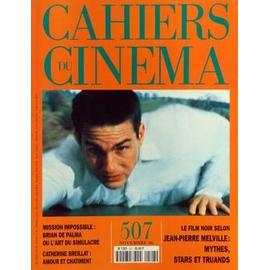
Mission: Impossible (Cahiers,
November 1996, N.507), w/ Editorial by Serge Toubiana, Brian de Palma ou l’invraisemblable vérité; Cahiers Critique, Le simulacre simulé, by Cédric Anger;
essay by Iannis Katsahnias, Le
monde-regard de Brian de Palma; and short-essay by Thierry Jousse, Mission: Impossible de la série au film.
Serge Toubiana, Editorial.
Brian de
Palma’s Mission: Impossible is an
oeuvre that’s really stimulating for both the eyes and the spirit… All the
while responding to a public demand (grosso
modo that of the spectacle), Mission:
Impossible is also an incredible exercise in mise en scène, guided by a few
really strong and relevant ideas about the virtual world, the manipulation of
gazes, doubles, the loss of senses and to the heart of things that are hidden…
There is in his oeuvre a hidden dimension, something that’s obsessional and sickly:
de Palma is the cinéaste par excellence
of passions and of melancholy… We know the
counter-argument: a spectacle-film, a commissioned product, a compromise with the
industry… Too many half-truths that don’t really allow you to see the actual
energy and intelligence of this cinéaste who from film after film is a termite
from inside the Hollywood spectacle… De Palma is without a doubt in the really
reserved circle of the best cinéastes in activity.
Cédric Anger, Le simulacre simulé.
Everything here
is the art of manipulation. The permanent simulacrum. In Mission: Impossible a mise en scène always hides another one and
every situation can be compared to a suitcase with either double or triple
compartments. It’s that the oeuvre plays a game directly with us, the
spectator. If the characters in the film don’t have any veritable existence then
it is in fact us the spectator who are its principal protagonists. As early as
its credit sequence, de Palma brings us right into the spectacle: we go through
the movements from watching events unfold on a screen to then seeing the events
unfold live as if the cinéaste was
literally allowing us to penetrate the image. Like Hitchcock, Brian de Palma is
not a cinéaste of distancing effect but of its opposite: that of an absolute
participation. Ethan Hunt is our double as he’s exposed to all of the dangers
on the screen – like an atom constantly in movement. The spectator enters right
into the action. De Palma can then play with the manipulation and orientation
of the information, from false identities and to total inversions between
appearances and reality… De Palma founds his system in a magical universe in
the sense of the theatrical magician who retracts and then reveals information
as he presents and removes information as a function to reveal information to
the spectator… Mission: Impossible tells
the story of nothing except the one of a character who finds himself inside of
a movement, decrypting it, becoming active in it and whose playing it all by
himself. Ethan Hunt decodes the mise en scènes that surround him and he conquers
them by taking up new appearances. The transformations and the make-up and the
different masks that he wears not only allows him to save himself but to take
possession of the mise en scène through an artifice. In this combat with his
spectator and this debauchery of manipulation, Brian de Palma re-introduces an
idea from the experimental and despised Raising
Cain that he already pushed really far: the image of a person who never
dies. De Palma bases his work in the presence of cinema in the minds of his spectators. In their visual memory. A scene
that is known by the public reappears suddenly on the screen but touched up and
re-worked. The suspense here doesn’t only spring from our knowledge of the
action (the spectator knows a little more than the main character) but of our
knowledge of other films (the spectator knows how similar scenes unfolded in
other films and expect certain events). The oeuvre of Brian de Palma is
quintessential maniérisme as he no longer nourishes his films from the world
directly but through a referential relationship of images from ancient films
(usually Hitchcockian) that experience a rebirth under our eyes but through the
image itself of a character who we thought was lost who then reappears. The character
no longer exists as a real person but only as an image that circulates and that
can be brought back as he desires. De Palma can then add to the confusion and
play up the blank slate and the expectations of the spy thriller where faces
circulate like independent images, disappearing between a whole game of
doppelgangers and masks, of decorations and make-up. All of the images are
susceptible of containing another one and everything susceptible to
representation is up to be changed. The image is never drained. The chaos of appearances
as played out in Mission: Impossible become
terrifying since there is no end. The last scene of the film where Ethan is in
the plane experiencing the same scene as Phelps did just like him and embarking
on a new mission is just like the ultimate image in Raising Cain where the principal character which we believed was
dead just reappeared… The confusion of appearances doesn’t get born here by the
mental trouble of the characters but from the chaos that is produced from the
world and its new technologies that by systematically passing us through
constant and multiple screens obliterates all the relationships to the réel and
with things. In Mission: Impossible de
Palma marks the ultimate stage in the logic of a materialist-capitalistic
occidental world: a universe that is totally mechanized where sensations and
corporeal jouissances are excluded and everything is a commodity object. There
are no longer subjects. The film describes a new world where images are the
masters and reign and where the human being has no place. Man is only now a
toy. A pawn that is disposed of by way of believing
they have the power of the mise en scène. How to keep that which circulates
all the time and which metamorphoses constantly? As each image is independent
and unseizable with its essence escaping itself and all fixity of its
enterprise, even though for a short instant it can be looked at, but with the
majority that the confirmation is that all pretention to hold the mise en scène
is vain and ephemeral… From Ethan to Phelps all of the way to Kittridge, the
manipulating man is called to then be manipulated. Each one is suddenly in the
flux of interchangeable images and this is the power of all of the mise en
scène that vanishes from itself, trapped in the game of farces and catches,
with the spider web of this world of images weaved to trap everything that
exists… Lost in the multitude of fluxes of this universe of images man is now
just a movement and his body an interchangeable vehicle. Reduced to the state
of an object, of a merchandise that moves around just like capital and
information in a perfect world without any flesh… The final scene on the Euro-train
reworks then through pushing it all of the way into excess the plane scene in
Hithcock’s North by Northwest, which
the film references many times: taking an element of the réel (here the train;
there, the plane) and utilizing all of its possible imaginary possibilities to
turn this scene from realistic into a oneiric delirium and with a plasticity that
soaks up all of the resources of the location… More bitter and pessimist then
it appears, Mission: Impossible as
it was made by Brian de Palma proves that he’s the veritable analyst of the
mutations of our society and of a civilization of images and technology.
Iannis
Katsahnias, Le monde-regard de Brian de
Palma.
At the
beginning, there’s an eye. The eye of the dead fish of Marion Crane (Janet
Leigh) in the shower in Psycho: a guardian
image of the tomb (guardian of the suppression for Hitchcock) and of its
opening itself (authorizing the luminous return of repression for Brian de
Palma). An attractive image becoming worrisome and occupying even an extreme
rank of horror: the eye of consciousness.
As Bataille wrote, “There seems, in fact,
impossible as subject for the eye to pronounce any other word than that of
seduction. Nothing is more attractive in the body of animals and of humans. But
the extreme seduction is probably at its limits that of horror.” In the
cinema of de Palma, the open eye of death successfully becomes a cannibal sweet (the eye of the Phantom/William
Finley leaving his orbit in Phantom of
the Paradise), telepathic (the phosphorescent blue eyes with extra-lucid
power by the maleficent Gillian/Amy Irving in The Fury). In Mission: Impossible,
the eye has become a camera in a world that is reigned by gazes… Claire (Emmanuelle
Béart) is moving, undulating, and unseizable as she risks in each instant to
loose herself and Ethan with her. One must perhaps have to go as far back as
Otto Preminger’s Laura to re-find
such a representation of the phantasm which has become a ghost… On this
double-gaze and gaze of objects, in the hands of de Palma the Visco glasses are
not just a simple gadget but have become an instrument that establishes a dialectic
of the gaze which pushes it to its limit and finishes by manipulating the gaze
of the character just as well as that of the spectator… Just like Oedipus,
Ethan Hunt goes towards the search of the guilty, searching for the person who put
together this machination that accused him of being the mole. Like Oedipus, the
guilty person is not him. In Oedipus the
King, who is guilty? Oedipus because he killed his father and had sex with
his mother? No. The guilty are the parents who abandoned him on the mountain to
save their own skin because an oracle predicted that he would do exactly that…
There is the computer password ‘job 314’… So when Ethan sees in the light ‘job’
he takes it for its biblical meaning. The reference is to the Book of Job and more precisely to
chapter 3 (Curses the Day) and verse
14 (‘with kings and rulers of the earth,
who built for themselves places now lying in ruins’). In light of the image
of Job, Ethan is a tragic hero betrayed by his father… One must here talk about
Tom Cruise, and to say how great his character adapts with each gesture, each
movement of his body, how his mourning anticipates the problems of an orphan
forced to patricide and how all of this is on his emancipated face… At the end
of the film, we re-find Ethan Hunt slumped in his chair on a plane with an
unknown destination. He seems out of it. At this moment here, Ethan now takes
the place of the spectator who has experienced two hours of jerky jouissance
made up of fluxes and refluxes, of continued slides, suspense, organismic
moments, brief moments of repose, and vertiginous mountains and peaks. Mission: Impossible is filled with
movements of jouissance that go up and moves around and give the illusion of
bliss, extinguishment and then regret.
Thierry Jousse, Mission: Impossible de la série au film.
Mission: Impossible is without a doubt
the most theoretical television series in the history of television… We’re
somewhere between John Frankenheimer’s The
Manchurian Candidate and Hitchcock’s Topaz…
What interested de Palma in all of this is its graphic vision and the
flattening of its characters. Confined by the television and comic book
influences, he would add an extra dimension that is properly ghostly. It’s just
like the navigating of another world, somewhere between life and death.
***
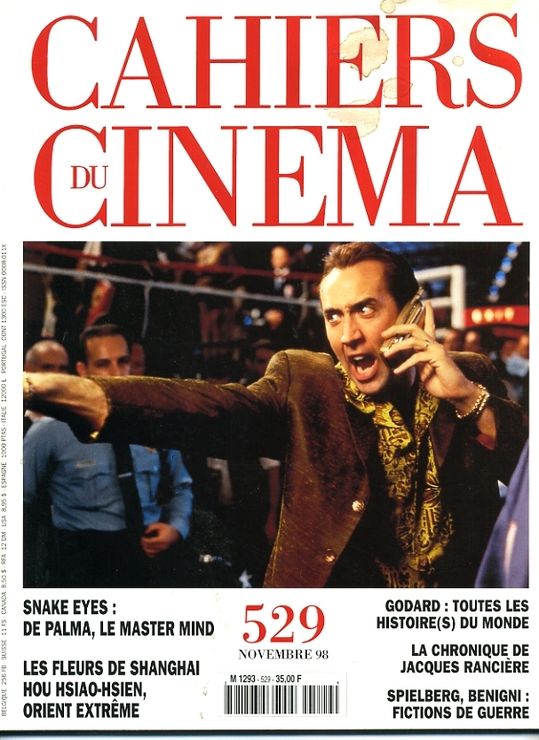
Snake Eyes (Cahiers,
November 1998, N.529), w/ Cahiers Critiques Jouissance
de l’oeil by Emmanuel Burdeau and a Dossier Brian de Palma, Le Master Mind essay by Stéphane Delorme.
Emmanuel
Burdeau, Jouissance de l’oeil.
Lies,
betrayal, manipulation. Cameras, headsets, recordings. Virtuosity,
masterfulness, mise en scène. Gazes,
eyes, points of views. Snake Eyes possesses
all that fans of Brian de Palma would expect from him… Snake Eyes continues the project of
Mission: Impossible but by
radicalizing it in two different ways. By the choice of staying in one unique
location and by its opening with a long-take of nearly fifteen minutes
(everything leading up to the bell going off near the end of the match), that
the whole rest of the film will deconstruct and analyze to the point that it
will extract, easily and with force, the final word on what exactly happened. As
long as the expression has a meaning, Snake
Eyes is in fact a theoretical film. What de Palma looses, not necessarily in
pleasure, is emotion, at least in relation to his two previous films, Carlito’s Way and Mission: Impossible, but which he gains in intellectual power,
through its theoretical seduction. Snake
Eyes, without being the best de Palma, is still a splendid film… For once,
the cinéaste is interested less in a figure whose trajectory coincides with
becoming a master or metteur en scène (Mission:
Impossible), then in a silent stoic man and his volition to know. So the question that is asked,
not that which is false (everything or nearly, as we know) but what exactly is
true for de Palma? What exactly is the truth for him? What exactly are the
conditions for there to be truths in the age
of the images? Another way to ask it: What does it mean to be today a cinéaste
of images – as would say Bazin – a cinéaste that believes in the power of
images? We can count in the film three images, no more, then exactly three
images that do not lie, which is verified without a doubt by multiple visions
of the film… This includes Tyler reawakening and opening his eyes after he
faked his KO with the truth being their shared gaze. ‘I see that you’re watching me.’ This is the first sign that for de
Palma that truth (and also lies) emerge from an eye (or eyes) and nothing other
then this. Tyler who is supposed to be KO had his eyes open and this is the
only critique we can make of him… The second truth is the totally ignored
camera with the name the zero gravity
flying eye with its blue eye. It’s a blue color that serves as the lost
background of television studios, that of an anonymous eye, with no end, empty,
a zero – an eye, period. We can believe it because it’s virgin, it doesn’t
belong to anybody. The images that it shows, the Anglo-Saxon call them a nobody’s shot. In opposition to the
flash-backs that have a subjective perspective (the point of view of Tyler, of
Dunne, of Julia) that can’t be credible as they cannot not be deceitful and
boring for the simple reason that they attempt to bring a truth from a
particular person. While in answer to the question, ‘what exactly happened during the match?’, the answer, for it to be
satisfactory, has to emerge from the interior of the situation itself. An image
in the past-tense – a flash-back – can then have meaning to explain and
elucidate more so than an image in the present which is surely suspect. Or
justly, Snake eyes requires these
multiple perspectives… The villain is identified around the halfway mark of the
film (by de Palma himself, in a direct shot, without any intermediary from other
point of views) but this is not enough as there remains to produce the proof of
his culpability in and by an image. The grandiose dénouement cherished by de
Palma (which recalls Raising Cain)
brings together the complexity of their logistics. Its machinery is heavy – in
occurrence, piece by piece, there’s a heavy storm and lightning, a huge globe,
a television team, a police car, and then Santoro, Dunne and Julia –, just like
how it’s heavy (difficult, and laborious) the advent of the proof-image where culpability
ceases to be an intuition or an knowledge that materializes to become evidence.
What’s really important to find the truth is nothing more then the necessary
detours to the production of these good images (the third and last) where the
camera and gun are revealed and where Dunne is found definitively in the frame; the death is confirmed as
it was recorded by this gaze. The gaze is then totally the truth, a true image
absorbed entirely in the act of showing, it’s a pure revelation (it reveals
only itself) – though what’s really there to see are eyes looking at other
eyes, that the eye that’s looking is an abyss, and which by looking at them it
signifies your death… An (important) cinéaste who persists to believe in
images. De Palma is someone that engages with resolving to see and know, to
identify absolutely with others, to leave to coincide with the confession that
there is no truth other than the act of seeing (or of being seen). Aside from
this evidence, which it revives in
extremis, there is no evidence except for this evidence. The truth can only
come from this condition of an extraction from the original (spatial,
personal)… We hadn’t forgotten what was Hitchcock’s task as he was addicted to
the robes of appearances (the cigarette that lights up in the middle of night
in Rear Window) had already switched
the gaze in the right direction before a film like North by Northwest (where can be found, already, the function of
the lure of the color red) and Vertigo doesn’t
separate the eye from intelligence. About the two section in Vertigo, Claude Ollier justly wrote
that, ‘It’s precisely through the spatial
localization shared by the two events which are visually identical, but
rationally divergent, where the trouble is born,’ a phrase that applies
marvelously to Snake Eyes, where
every shot is in a way a superimposition of two scenes pulled from the two
parts of the Hitchcock film. From one cinéaste to the other one, what has
changed (what is aggravated) is the manner of how the world is established by themselves
through a significant organization of appearances where between seeing and reading that the interval continues to expand… Snake Eyes moves through in a Hitchcock-like manner from the
general to the specific and through continuity to discontinuity from the
transparency of the opening long-take to its later montage to its dénouement. Once
there was only one camera but now there are five-hundred (that of the
surveillance dispositif). Exit the
one grand hall that was undividable, here are now hallways, hotel rooms,
compartments, cells and other rooms – we see that Snake Eyes is not too far from the experimental documentary on
insects that de Palma declared, not without some sincerity, wanting to direct
after Mission: Impossible… The
program is the following: first off to brake up the montage of the world, the
immanent montage of the scene (what is hidden behind the dozen split-screens) and then to substitute
his own montage, his own split-screens.
So then there is the fallacious continuity which lives out the productive
discontinuity of the truth. Obligatory montage, if you like. A way to say that
a proof isn’t anything to dispose off of the surface of things and that you
just pick up: it’s something that is fabricated. A way also for de Palma to be
loyal but not to the Mabuse of Lang
but to the Touch of Evil of Welles…
A faster eroticism (and game, naturally) – but is virtuosity nothing other then
the eroticization of the force of the masterfulness and speed? Ubiquity,
metamorphoses and frankly steeping through the spaces and frontiers with
whispers and long distance contact when it’s with the good usage of technology
like it is here with Santoro. The cinema of de Palma has touched upon an enchantment,
towards a magic that to his eyes is defined maybe like the detained power by
the elected, those that live in the space without ever adhering completely to
it – who fly from frame to frame. De Palma loves technology, he thinks with it, which explains his taste
for the split-screen, which he
remains to this day the best practitioner of and which he proves quite readily.
This fact again makes him closer to Welles a million more times then to Lang…
With de Palma what is definitively beautiful is that there can’t be a stunning
cinematography without a theoretical reflection, which is a major proponent of
his operations. We experience a jouissance the same way that we think: with our
eyes.
Stéphane
Delorme, A maintes reprises.
With
de Palma, there is no outside. We are
immediately in a space circumscribed that needs to be surveyed, do a detailed
analysis. There is always enough to see on the inside so that we do not feel an
urge to go look elsewhere. As a grand obsessional, de Palma inscribes the
infinite inside. Carrie, with her murderous gaze, violently shuts all of the doors
of the hall to work in the pieces of the interior, in grids, to analyze and
massacre everything that moves. The same kind of minutia, the same kind of fury
with de Palma: to install himself within a scene, to examine it in detail,
multiply the angles, the tracks, and the motifs. Then to disfigure, combine,
dilate. To disseminate, essentially. This dissemination of the scene has for a
name film. Snake Eyes, like for the majority of de Palma’s films reposes on
the reprisal of an inaugural scene… The filmic unity for de Palma isn’t an
image nor a shot but the scene. All of de Palma’s films circle around one
single scene: the ball in Carrie,
the pursuit outside of the institute in The
Fury, the elevator in Dressed to
Kill. The different demarcations (slow-motion, the split-screens, the false connections, or, in Snake Eyes, the long-take) make these scenes a detachable autonomous
piece. The scenes are their own matrixes. They intervene at strategic moments:
at the beginning (which is normal, since it’s what kicks starts the film) or elsewhere. It’s this scene that sets off
the images; it’s what projects them. It is a reservoir of images and motifs
which the films voluntarily rely on and extracts… If de Palma is an important cinéaste
then it’s partly because he takes really seriously the principal of the reprisal:
de Palma cites Hitchcockian scenes not to perform an eye-wink to the audience
but to work in the mode of the
analysis or of the anamorphosis. The analysis deconstructs the scene by multiplying
it into fragments that afterwards can be composed or combined a totally
different way: so that with each reprisal of the shower scene from Psycho, de Palma reveals a new detail
from the original scene to make it the center of this new composition (the
whiteness in Carrie, the hand in Dressed to Kill, the scream in Blow Out). The anamorphosis is a
procedure that is less maniacal, more obsessional, that doesn’t duplicate the
scene but elongates it, deforms it, all the while rendering it monstrous. So
the kiss scene from Vertigo in Body Double or the scene in the museum
from Vertigo in Dressed to Kill. The scene, just like a snake, deploys its orbs,
unwraps, and unfolds to fascinate the spectator… His second model is that of symmetry:
the reprisal is no longer the unfolding of the potentiality of the infinities
of a scene but a folding of its effective content. Mission: Impossible and Snake
Eyes reveals this model. As they progress by returning and inversing the
origins of their images. The stakes are no longer what’s possible but the réel;
the apparition of a system of opposing structures between the visible and the
invisible, between what’s shown and the outside-of-the-frame, the metteur en
scène and the actor. The reprisal is no longer the jouissance multiplication of
the solutions of readings but the search for what really happened… This process
of retuning to the image surely recalls
the savage tactics of Dario Argento whose giallos
(The Bird with the Crystal Plumage, Deep Red) rests on the painful search for the missing image: it’s before anything else
a work on oneself, on one’s memory, that the character may be able to revive
the image. The origins of this type of reconstitution is evidently Antonioni’s Blow Up which used the technique
(enlarging, cutting up, montage) to find the missing image… In the search for
the real image, which seems like since Mission:
Impossible has become his obsession, de Palma has abandoned his maniériste vein
which found its peak in Raising Cain.
For the maniérist, no particular angle of vision is privileged: the world of
images leaves no room for any truths. Each version has its own weight, that of
its evanescence. An image doesn’t kill, as it always reunites, haunted by the
characters that are only ever interchangeable apparitions: the reality unfolds
in a game of infinite substitutions. We can regret that de Palma, in his diptych
Mission: Impossible/Snake Eyes, has
abandoned this vertiginous game to replace it with this investigation where the
truth is rendered naked. In these two films, the (pedagogic) preoccupation is
the same: one must learn how to look, one must discover the contre-champs, that is to say the space
of the metteur en scène to then become the metteur en scène in one’s own right…
Snake Eyes is a film about hubris: Rick Santoro (Nicolas Cage)
takes himself to be a god (‘I am the
king’ he declares in front of a delirious crowd). Then it’s normal that the
real gods would punish him. Rick Santoro is a Greek hero in a Hawaiian shirt, a
mixture between Prometheus and Oedipus: dressed in his snake skin, just like
David Lynch’s sailor, he defies the Olympian gods, then he creeps, humiliated,
blind, pulled along like a marionette. Already, Courtland (Obsession) was inflated by pride to reach the beyond. One does not
play at the expense to just play with the gods as they are installed. One must
inflate the scene up to the point that it explodes (to blow out) to deflate the self-satisfaction of little boys that pretend
to be men. To pierce the skin of the frog that believes he’s bigger then cattle.
For this, nothing other then a good point that’s really sharp… The scene for de
Palma has a really precise sense: it abolishes itself in its final point. The
point is the venomous injection that congeals the scene. It’s a gunshot, a cry
and a flood of blood (the beginning of Carrie).
The art of the point is not only a visual rhetorical figure: the point is
materialized, disseminated a little everywhere, in the corners and hidden, like
an advance taste of the of the sounds before the cymbals finale. In Raising Cain, the grand final scene,
maybe the summit of de Palma’s oeuvre, unfolds around the menace of a point:
that of the grand clock, disposed meticulously in the frame during the chase
for Jack… There are signs that announce the point but then how to see them? If
the first scene in Snake Eyes resembles
a lot the grand scene in the Royal Albert Hall in The Man Who Knew Too Much, though it does not obey any of the
Hithcockian principals of suspense that renders immediately all of the signs
readable for the spectator. In the Hitchcock film, the spectator knows that in
a precise instant (the striking of the cymbals, the shot will go off). In Snake Eyes, there are so many signs,
but they are not referential during the first vision. How to know that the
signal for the gun shot, this time here, will be during the fall of the boxer?
No suspense: but instead, the surprise of the point, that which penetrates
through the screen… The art of the point possesses equally its limits. The
long-take that concludes the film like a loop puts into place workers who are
pursuing their work in front of a casino. It finishes with an extreme close-up
of a man’s hand. It’s a shot that’s absolutely unexpected (the credits are
rolling) that surprises the spectator who believed that he’s already seen it
all. It’s a admirable shot where de Palma simply films the work, in an hors-film
that opens the oeuvre to the outside world. The hand that caresses the stone
column and the camera that slowly approaches up to the point of filling the
screen. At the instant where the hand pulls back it reveals the red stone
that’s cemented into the column. De Palma has just revealed his final arrow.
But there’s a deception: was he only filming this hand because the ruby was
hiding behind it? This ruby (but do we even remember it?) belongs to the young redheaded
women who Dunne killed. The meaning is clear: casinos are built over dead
bodies. But the surprise of the ruby says something else: we furtively think of
the last shot of Hitchcock’s Family Plot,
that of a hidden diamond in a chandelier, which played like a metaphor for the
oeuvre. But would the metaphor not be better if the hand stayed on top of it?
The discourse (‘beware of appearances’) finally makes one weary. We would prefer
if de Palma would remain on the surface, either to multiply the power of its
images (Raising Cain) or either to
be interested to get closer to its raw material (the body or the stone). But of
course, there finally remains enormous and surprising hand but the smaller
brilliant ruby pierces the mystery of its presence. An awkward revelation that
risks to distract from the real splendor of Snake Eyes.
 Every June
for cinephiles who read Cinema Scope
the same questions are always asked: When does it come out? What’s
going to be on the cover? It has become almost like a game. Though there are always some
hints. Like what has the Cinema
Scope account and its regular contributors tweeted from the
Croisette? From there it’s a process of
elimination with usually two or three strong contenders. After that it's
a guessing game until the cover is finally revealed. With the new summer issue it’s Maren Ade’s Toni Erdmann that makes the final cut. But it’s not just the
summer issue that’s important as with an exclusive four issues a year the
quality and the anticipation value of these cover films are trusted more so
than even each year’s Palme d'Or.
Every June
for cinephiles who read Cinema Scope
the same questions are always asked: When does it come out? What’s
going to be on the cover? It has become almost like a game. Though there are always some
hints. Like what has the Cinema
Scope account and its regular contributors tweeted from the
Croisette? From there it’s a process of
elimination with usually two or three strong contenders. After that it's
a guessing game until the cover is finally revealed. With the new summer issue it’s Maren Ade’s Toni Erdmann that makes the final cut. But it’s not just the
summer issue that’s important as with an exclusive four issues a year the
quality and the anticipation value of these cover films are trusted more so
than even each year’s Palme d'Or.